Scholars at the Graduate School of Education continue to explore children’s well-being and how school closures during the pandemic shaped their lives.
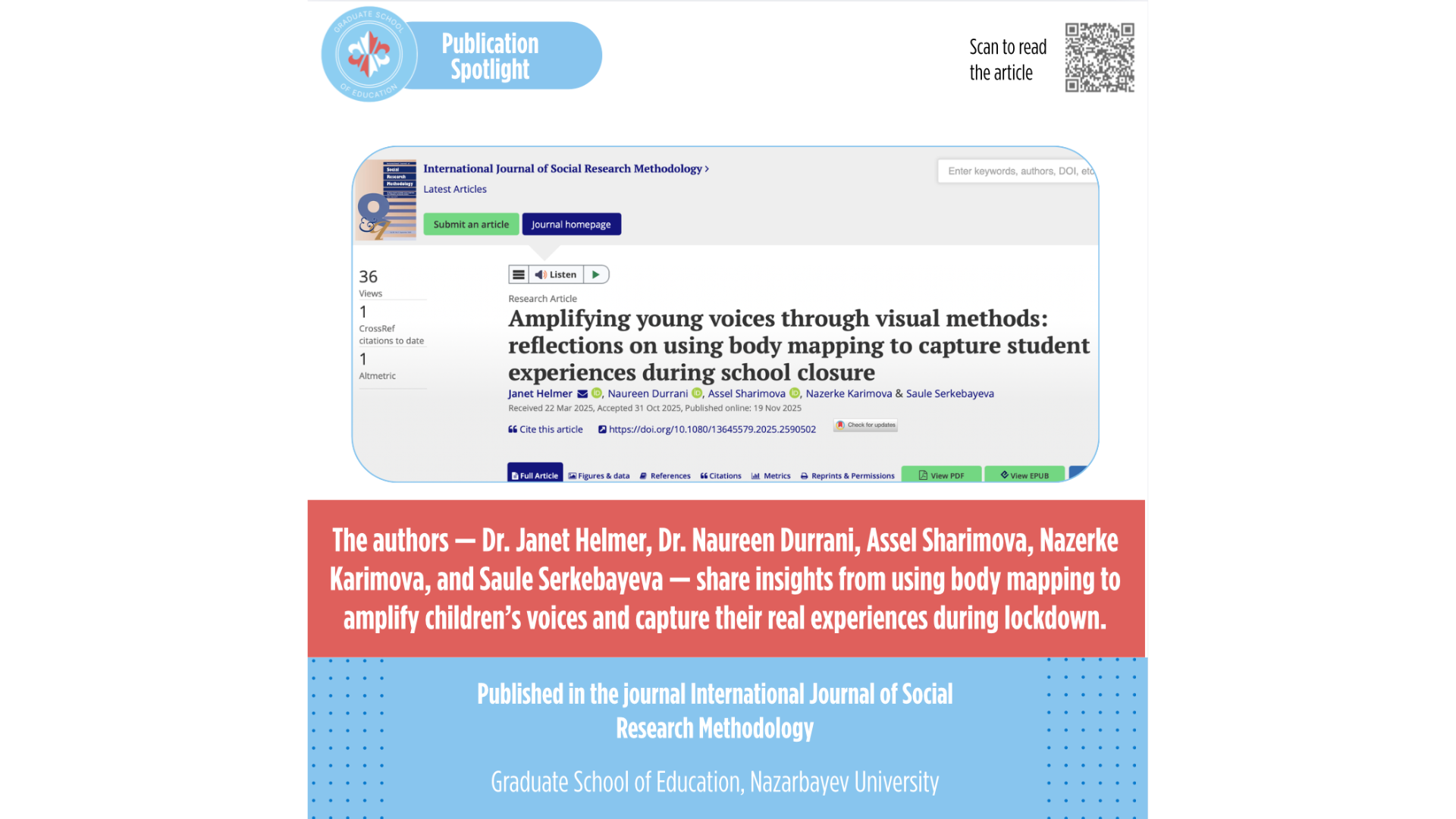
In a newly published article in the International Journal of Social Research Methodology, the authors — Janet Helmer, Naureen Durrani, Assel Sharimova, Nazerke Karimova, and Saule Serkebayeva — share insights from using body mapping to amplify children’s voices and capture their real experiences during lockdown.
Amplifying young voices through visual methods: reflections on using body mapping to capture student experiences during school closure
Read the article
Four Key Highlights:
What challenge did we address?
How to share meaningful research — such as studies on COVID-19 school closures — when the topic is no longer in the spotlight. The solution: emphasize innovative research methods that remain relevant today.
Why is this important?
Good methods never expire. Even as public attention shifts, strong methodological tools continue to shape how we study learning, resilience, and children’s well-being.
What did we learn?
Body mapping gave children a safe and creative way to express what lockdown really felt like. Their visual stories revealed deep emotions, family pressures, and surprising insights far beyond academics.
What’s next?
We need more creative, child-centred methods that allow young people to shape research about their own lives. Body mapping is just the beginning.
GSE remains committed to advancing research that amplifies young voices and deepens our understanding of well-being in education.
#NUGSE #ChildWellbeing #Research #BodyMapping #EducationResearch #NUKazakhstan
In a newly published article in the International Journal of Social Research Methodology, the authors — Janet Helmer, Naureen Durrani, Assel Sharimova, Nazerke Karimova, and Saule Serkebayeva — share insights from using body mapping to amplify children’s voices and capture their real experiences during lockdown.
Amplifying young voices through visual methods: reflections on using body mapping to capture student experiences during school closure
Read the article
Four Key Highlights:
What challenge did we address?
How to share meaningful research — such as studies on COVID-19 school closures — when the topic is no longer in the spotlight. The solution: emphasize innovative research methods that remain relevant today.
Why is this important?
Good methods never expire. Even as public attention shifts, strong methodological tools continue to shape how we study learning, resilience, and children’s well-being.
What did we learn?
Body mapping gave children a safe and creative way to express what lockdown really felt like. Their visual stories revealed deep emotions, family pressures, and surprising insights far beyond academics.
What’s next?
We need more creative, child-centred methods that allow young people to shape research about their own lives. Body mapping is just the beginning.
GSE remains committed to advancing research that amplifies young voices and deepens our understanding of well-being in education.
#NUGSE #ChildWellbeing #Research #BodyMapping #EducationResearch #NUKazakhstan