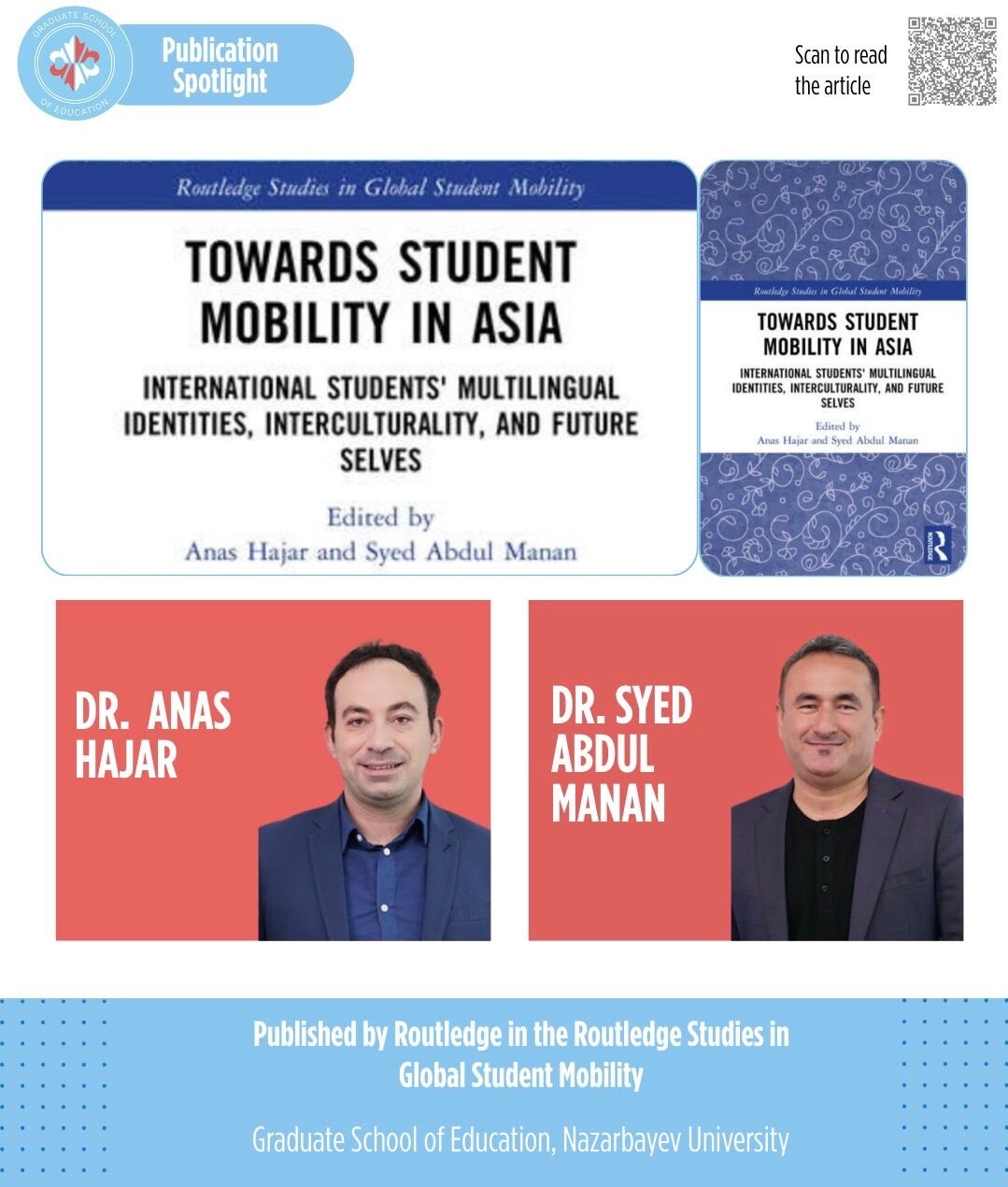
NUGSE professors Anas Hajar and Syed Abdul Manan have published a new book, Towards Student Mobility in Asia: International Students’ Multilingual Identities, Interculturality, and Future Selves, focusing on the linguistic, cultural, and academic experiences of international students studying in Asian countries.
Summary: This volume features a wide range of important chapters that address themes such as identity reconstruction, intercultural engagement, employability, linguistic racism, and the challenges and opportunities of studying at English-medium universities. It also explores international students’ experiences of learning languages other than English in host countries and highlights pedagogical interventions aimed at supporting language learning and intercultural development.
The book brings together research and insights from across diverse Asian contexts, including Mainland China, Hong Kong, Kazakhstan, Singapore, Malaysia, Japan, South Korea, Indonesia, Saudi Arabia, Turkey, the United Arab Emirates, and Vietnam. Our contributors offer valuable empirical evidence and conceptual reflections on the dynamic interplay between language, culture, and identity in transnational education.
What inspired this study?
This volume was inspired by a growing concern that international student mobility in Asia has often been examined through frameworks developed largely in Western contexts, with limited attention to the voices, realities, and complexities of students moving within and across Asian societies. Much existing research has focused on Anglophone destinations and treated mobility mainly as an academic or linguistic outcome, often overlooking students’ emotional lives, identity struggles, and intercultural encounters. In response, this book was motivated by the need to rethink international student mobility through a more holistic, Asian-centred lens that recognises students as “whole persons” whose academic journeys are inseparable from their social, cultural, political, and emotional worlds. By bringing together empirical work from diverse Asian contexts, including both established and emerging education hubs, the volume seeks to address the notable underrepresentation of Asia in international mobility scholarship and to challenge dominant narratives that position the West as the natural centre of international education.
Key takeaway
International student mobility in Asia is not a single, uniform experience but a deeply complex process shaped by language, power, identity, and inequality. One major takeaway from this volume is that studying abroad does not automatically lead to intercultural competence, linguistic success, or personal transformation. Students’ experiences are shaped by institutional practices, local language policies, racial and linguistic hierarchies, and the extent to which host societies are willing to recognise them as legitimate participants. The chapters demonstrate that international students in Asia are active agents who constantly negotiate belonging, invest in multiple languages, and imagine diverse future selves, rather than simply adapting to predetermined educational paths. By foregrounding multilingualism, interculturality, and identity formation, the book highlights the need for more inclusive policies, stronger institutional support, and pedagogical practices that value linguistic diversity and emotional well-being. Ultimately, the volume calls for a reimagining of international education in Asia as a socially embedded and morally significant endeavour, not merely a market-driven or credential-focused activity.
Who could find this work useful, and how might it be beneficial for them?
This volume will be especially useful for scholars and postgraduate students in applied linguistics, international education, and intercultural studies who are interested in understanding student mobility beyond Western-dominated frameworks. It offers Asia-focused perspectives on language learning, identity negotiation, and intercultural engagement, supporting more inclusive and context-sensitive research in the field.
University lecturers, programme coordinators, and student support staff will find the book valuable for its insights into international students’ academic, social, and emotional experiences. The chapters highlight common challenges such as language barriers, belonging, and cultural adjustment, which can inform better teaching practices and student support services.
The book will also benefit policymakers and university leaders seeking to develop fairer and more sustainable internationalisation strategies, as well as prospective international students and their families who wish to gain a realistic understanding of studying in Asia and to prepare more effectively for its linguistic, academic, and cultural demands.
Summary: This volume features a wide range of important chapters that address themes such as identity reconstruction, intercultural engagement, employability, linguistic racism, and the challenges and opportunities of studying at English-medium universities. It also explores international students’ experiences of learning languages other than English in host countries and highlights pedagogical interventions aimed at supporting language learning and intercultural development.
The book brings together research and insights from across diverse Asian contexts, including Mainland China, Hong Kong, Kazakhstan, Singapore, Malaysia, Japan, South Korea, Indonesia, Saudi Arabia, Turkey, the United Arab Emirates, and Vietnam. Our contributors offer valuable empirical evidence and conceptual reflections on the dynamic interplay between language, culture, and identity in transnational education.
What inspired this study?
This volume was inspired by a growing concern that international student mobility in Asia has often been examined through frameworks developed largely in Western contexts, with limited attention to the voices, realities, and complexities of students moving within and across Asian societies. Much existing research has focused on Anglophone destinations and treated mobility mainly as an academic or linguistic outcome, often overlooking students’ emotional lives, identity struggles, and intercultural encounters. In response, this book was motivated by the need to rethink international student mobility through a more holistic, Asian-centred lens that recognises students as “whole persons” whose academic journeys are inseparable from their social, cultural, political, and emotional worlds. By bringing together empirical work from diverse Asian contexts, including both established and emerging education hubs, the volume seeks to address the notable underrepresentation of Asia in international mobility scholarship and to challenge dominant narratives that position the West as the natural centre of international education.
Key takeaway
International student mobility in Asia is not a single, uniform experience but a deeply complex process shaped by language, power, identity, and inequality. One major takeaway from this volume is that studying abroad does not automatically lead to intercultural competence, linguistic success, or personal transformation. Students’ experiences are shaped by institutional practices, local language policies, racial and linguistic hierarchies, and the extent to which host societies are willing to recognise them as legitimate participants. The chapters demonstrate that international students in Asia are active agents who constantly negotiate belonging, invest in multiple languages, and imagine diverse future selves, rather than simply adapting to predetermined educational paths. By foregrounding multilingualism, interculturality, and identity formation, the book highlights the need for more inclusive policies, stronger institutional support, and pedagogical practices that value linguistic diversity and emotional well-being. Ultimately, the volume calls for a reimagining of international education in Asia as a socially embedded and morally significant endeavour, not merely a market-driven or credential-focused activity.
Who could find this work useful, and how might it be beneficial for them?
This volume will be especially useful for scholars and postgraduate students in applied linguistics, international education, and intercultural studies who are interested in understanding student mobility beyond Western-dominated frameworks. It offers Asia-focused perspectives on language learning, identity negotiation, and intercultural engagement, supporting more inclusive and context-sensitive research in the field.
University lecturers, programme coordinators, and student support staff will find the book valuable for its insights into international students’ academic, social, and emotional experiences. The chapters highlight common challenges such as language barriers, belonging, and cultural adjustment, which can inform better teaching practices and student support services.
The book will also benefit policymakers and university leaders seeking to develop fairer and more sustainable internationalisation strategies, as well as prospective international students and their families who wish to gain a realistic understanding of studying in Asia and to prepare more effectively for its linguistic, academic, and cultural demands.